← BACK TO RESOURCES
MA-UNI - Comprehensive Investor Brief
A concise overview for robotics companies,
AI developers, manufacturing partners and deep-tech investors.
FROM A WORKING PROTOTYPE
TO AN INDUSTRIAL HUMANOID PLATFORM
PROJECT OVERVIEW
What Is MA-UNI?
MA-UNI is an independently developed humanoid robotics project created in Bulgaria.
The project combines robotics, engineering, artificial intelligence,
electronics, software development, digital fabrication and industrial design
within one original humanoid platform.
The current humanoid prototype demonstrates that MA-UNI has already crossed
the boundary between concept and physical realization.
One creator.
One working prototype.
One opportunity to build something much larger.
THE CURRENT PROTOTYPE
A Working Physical Foundation
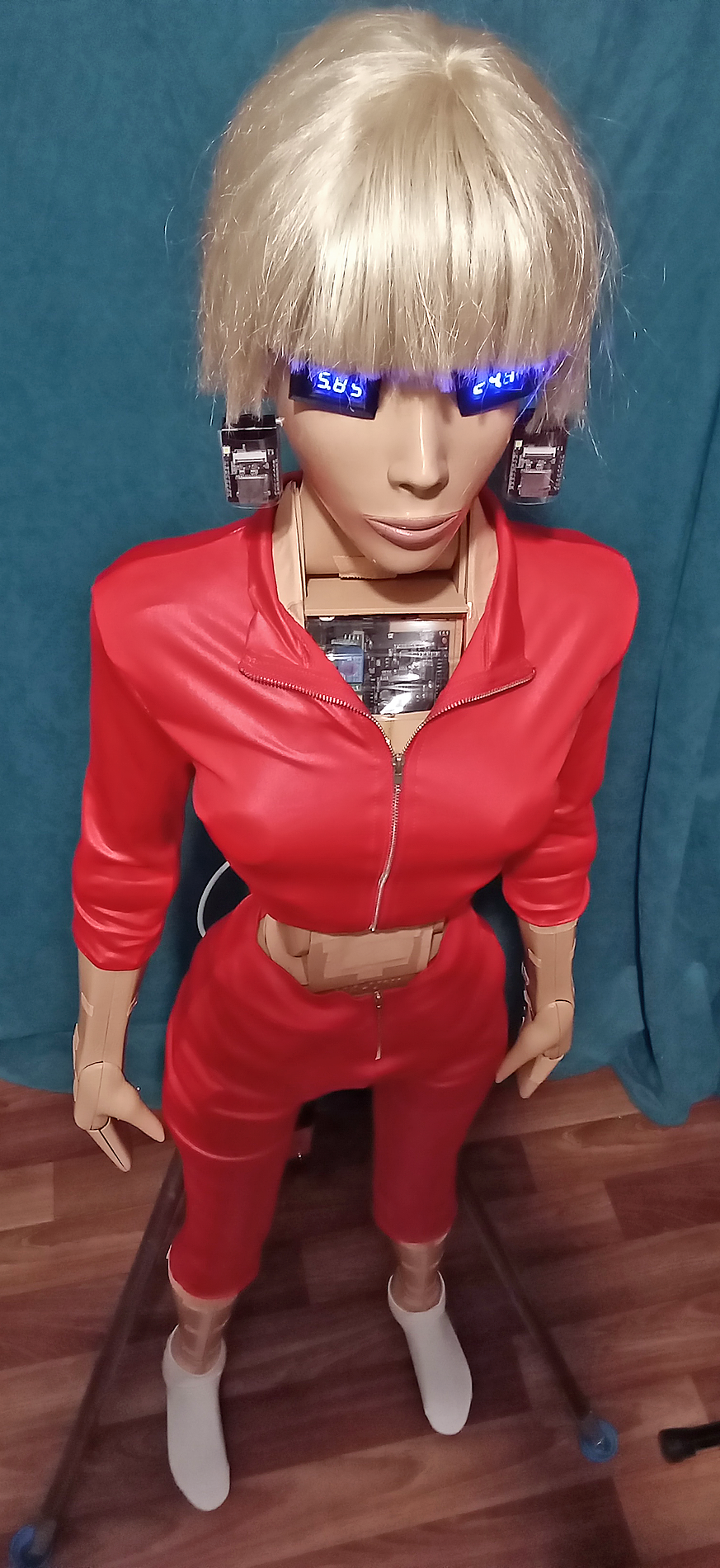
The existing prototype demonstrates the physical architecture,
humanoid proportions, articulated body structure, visual identity
and the initial engineering direction of MA-UNI.
The prototype proves that the architecture exists physically.
The next stage is to engineer it professionally.
THE CREATOR
Built From The Ground Up
MA-UNI has been independently developed from the initial idea to a full-scale physical prototype.
The development includes concept creation, humanoid architecture,
mechanical and structural engineering, electronics integration,
software development, 3D modelling, fabrication, assembly,
testing and industrial design.
The project demonstrates the ability to create a complex robotics system independently before industrial development begins.
PHYSICAL BODY
Technological Possibilities
The development of MA-UNI reflects the current limitations of available technologies. At the present stage of technological development, building a robot that fully replicates the human body — including artificial muscles, realistic skin, advanced sensory systems and other human-like characteristics — remains extremely difficult.
For this reason, the project follows a gradual development approach, exploring alternative technological pathways and progressively integrating more advanced solutions as they become viable.
In the early stages, pneumatic artificial muscles and other alternative actuation technologies were considered and investigated as potential solutions. However, these technologies are not yet sufficiently mature to provide the combination of reliability, controllability, compactness and practicality required for the MA-UNI platform.
At present, electrically driven robotic systems using servo motors and electronic control offer one of the most practical approaches. They allow the system to remain relatively simple, precisely controllable and highly adaptable, while providing a solid foundation for further development.
Based on these considerations, the current MA-UNI robotic body was designed as a lightweight electrical and mechanical platform that can progressively evolve as technology advances — particularly in the field of artificial elastic muscles and other advanced actuation systems.
At this stage, MA-UNI therefore uses a deliberately simple and fundamental physical body: a rigid mechanical structure with integrated servo motors and a high degree of mechanical flexibility.
The current body is not intended to represent the final form of MA-UNI. It represents a technological foundation — one that can be progressively transformed and expanded as new technologies become sufficiently mature for integration.
The objective is not to imitate the human body all at once, but to build the technological foundation that can gradually evolve toward it.
04 / CURRENT FOUNDATION
What Already Exists
| Area |
Status |
| Original humanoid concept |
Completed |
| Full-scale physical prototype |
Completed |
| Mechanical architecture |
Completed |
| Electronics integration |
Completed |
| Software control architecture |
Completed |
| 3D structural fabrication |
Completed |
| Project documentation |
Completed |
A substantial physical foundation already exists.
Future investment accelerates development rather than starts it.
DEVELOPMENT ROADMAP
From Prototype To Platform
Stage 01
Working Prototype Foundation
Stage 02
Engineering Refinement
Stage 03
AI Humanoid Platform
Stage 04
Industrial Product Platform
Stage 05
MA-UNI Ecosystem
Stage 06
MA-UNI Human-Like Body Development
Each stage expands the technological capability of the existing architecture rather than replacing it.
NEXT DEVELOPMENT STAGE
Engineering Priorities
Industrial Engineering
Mechanical redesign, durability and optimization.
Actuation
Industrial-grade joints and motion systems.
Electronics
Integrated embedded architecture and sensing.
Artificial Intelligence
Perception, language and autonomous interaction.
Manufacturing
Materials, tooling and scalable production methods.
Validation
Testing, reliability and safety engineering.
The next stage is engineering development, not another conceptual exercise.
ARTIFICIAL INTELLIGENCE
Why MA-UNIX Comes Next
Artificial Intelligence is viewed as the next technological layer of MA-UNI,
built upon an already existing physical platform.
Above this physical foundation, MA-UNIX is being conceived as the dedicated operating system and software architecture for MA-UNI.
Inspired by the principles and foundations of UNIX and Linux, MA-UNIX is intended to provide a specialized environment for controlling, coordinating and integrating the robot’s hardware, software and future intelligent capabilities.
Standard AI is only the starting point.
MA-UNIX (MA-UNI OS) is the next evolutionary layer of MA-UNI.

TECHNOLOGICAL ECOSYSTEM
The MA-UNI Technology Stack
The long-term vision is to develop an architecture in which robotics, operating-system technology, artificial intelligence, perception, communication and higher-level autonomous functions can operate as parts of one integrated ecosystem.
The objective is not simply to build another humanoid robot. It is to establish a technological foundation capable of evolving across multiple disciplines.
MA-UNI is the physical platform. MA-UNIX is the software foundation. Together, they form the beginning of a broader technological ecosystem.
THE NEXT DEVELOPMENT STAGE
A Short Business & Technology Plan
MA-UNI has reached the stage of a completed core concept and a working
physical prototype. From this point forward, the most effective approach
from both a technical and organisational perspective would be to establish
a small, focused multidisciplinary development team.
The initial team could include specialists in:
- Mechanical and robotics engineering
- Electronics and embedded systems
- Software development and robotics programming
- Artificial intelligence
- 3D modelling and fabrication
- Industrial and product design
- Marketing and communications
The objective would be to transform the existing MA-UNI foundation into a
professional development and production-oriented prototype
capable of demonstrating the platform’s principal functions, architecture
and technological potential.
Such a prototype would provide a stronger technical and commercial basis
for subsequent investment, industrial partnerships and, potentially,
preparation for future manufacturing.
INITIAL DEVELOPMENT BUDGET
An indicative budget for this initial development period could be in the range of:
USD 100,000–500,000
The actual requirement would depend on the final technical objectives,
team structure, component costs, manufacturing approach, testing
requirements and intended application of the prototype.
The purpose of this initial investment would not be mass production.
It would be to establish a professionally engineered and validated
prototype that can serve as a foundation for the next level of financing
and industrial development.
THREE DEVELOPMENT STAGES
01 — PROFESSIONAL PROTOTYPE
Approx. 1 year
Further development of the existing concept into an initial professional
prototype, including engineering refinement, subsystem integration and
implementation of the principal functions and characteristics of the
MA-UNI platform.
02 — TECHNOLOGY REFINEMENT & TESTING
Approx. 1 year
Systematic testing, technological optimisation, identification and
correction of weaknesses, and implementation of the engineering changes
required to improve reliability, performance and manufacturability.
03 — PRE-PRODUCTION PROTOTYPE & PRESENTATION
Approx. 1 year
Final engineering and finishing work, preparation of the prototype for
public demonstration and potential industrial evaluation, together with
supporting activities such as documentation, communications, marketing
and public presentation.
EXPECTED DEVELOPMENT PERIOD
The indicative development period is approximately three years.
This timeline should not be considered fixed. Depending on the technical
objectives, available resources, team structure, manufacturing capabilities
and intended application, the programme could potentially be accelerated
to approximately two years or less.
The three-year model therefore represents a realistic development framework
rather than a strict schedule.
THE STRATEGIC OBJECTIVE
The primary objective of this stage is to move MA-UNI from an independently
developed working prototype toward a
professionally engineered and validated development platform.
This would create the basis for:
- larger-scale investment;
- strategic robotics and technology partnerships;
- industrial engineering and manufacturing collaboration;
- advanced AI and software development;
- technology validation and demonstration;
- and, ultimately, evaluation of potential commercial and industrial applications.
The existing MA-UNI prototype provides the starting point. The next stage
is to build the team, engineering infrastructure and technological
capabilities required to take that foundation further.
The goal is not simply to build the next prototype.
The goal is to establish the foundation for a scalable humanoid robotics platform.
STAND → WALK → ACT AUTONOMOUSLY
Indicative Technical Development Milestones
The next stage of MA-UNI development can be further defined through a
series of concrete technical milestones. These milestones represent
the principal functional objectives required to progressively transform
the current physical prototype into a more capable and increasingly
autonomous humanoid robotic platform.
The sequence is indicative and may evolve depending on engineering
results, available technologies, testing and the resources available
during development.
01 — STATIC STABILITY
Development of the balance and control systems required for MA-UNI to
stand upright independently and maintain a stable position without
external support.
02 — CONTROLLED WALKING
Development of stable movement control and the ability to perform
controlled, consecutive steps while maintaining balance and a
predictable walking pattern.
03 — BASIC ENVIRONMENTAL AWARENESS
Integration of sensors and software capabilities enabling MA-UNI to
perceive and interpret basic information about its immediate
environment and orient itself within it.
04 — FALL DETECTION & RECOVERY
Development of systems capable of detecting loss of balance and
initiating appropriate responses. The longer-term objective is for
MA-UNI to safely recover from a fall and return independently to an
upright position.
05 — INTEGRATED AUTONOMOUS MOVEMENT
Integration of balance, walking, environmental perception and recovery
capabilities into a unified system supporting increasingly autonomous
physical movement and interaction with the environment.
These milestones represent a gradual transition from a mechanically
controlled humanoid platform toward a system capable of stable
movement, basic environmental awareness and increasingly autonomous
behaviour.
STAND → WALK → PERCEIVE → RECOVER → ACT AUTONOMOUSLY
DESIGN PHILOSOPHY
Building a Humanoid for Everyday Life
The primary objective of MA-UNI is not to create the fastest,
strongest, most dynamic or most technically extreme humanoid robot.
There are already specialized humanoid robots being developed with
exactly those objectives in mind, focusing on maximum performance,
speed, strength or highly specialized industrial applications.
MA-UNI follows a different design philosophy.
The goal is to create an elegant, accessible and human-oriented
humanoid platform designed for everyday environments rather than
extreme technical demonstrations.
MA-UNI is intended to perform fundamental human-like movements,
interact naturally with people and adapt comfortably to the spaces
where humans live and work.
Every stage of development therefore prioritizes simplicity,
adaptability, modularity and the possibility of continuous evolution
instead of pursuing maximum mechanical complexity from the beginning.
Design Priorities
- Human-like movement rather than maximum speed.
- Natural interaction rather than purely technical performance.
- Elegant mechanical design rather than excessive complexity.
- Accessibility and scalability rather than exclusive laboratory hardware.
- Continuous evolution as technology matures.
MA-UNI is designed to become a natural presence in everyday human
environments — not simply an impressive technological machine.
The long-term vision is to develop a humanoid platform that people can
communicate with naturally, live alongside comfortably and continuously
expand through new technologies such as MA-UNIX, artificial intelligence
and future human-like body systems.
PARTNERSHIP MODEL
Different Partners.
Different Roles.
| PARTNER |
ROLE |
| Robotics Companies |
Engineering and system integration. |
| AI Companies |
Perception, language and software intelligence. |
| Industrial Manufacturers |
Production engineering and scaling. |
| Research Institutions |
Advanced robotics collaboration. |
| Strategic Investors |
Capital and long-term development partnership. |
Partnership does not require ownership of the entire vision.
Different organizations can build different parts of MA-UNI.
WHY NOW?
Six Reasons
To Look At MA-UNI
01
A working physical humanoid prototype already exists.
02
The project has been independently developed from the ground up.
03
The architecture is original and designed for future evolution.
04
A clear engineering roadmap already exists.
05
MA-UNI is open to strategic collaboration at the right development stage.
06
MA-UNI is envisioned as an ecosystem that could evolve into a multidisciplinary field of its own.
AN INVITATION TO COLLABORATE
Questions Worth Exploring Together
Can this architecture evolve into a new industrial humanoid platform?
Which engineering decisions should define the next prototype generation?
How should AI become part of the MA-UNI platform?
Which manufacturing strategy is appropriate for future scaling?
What commercial opportunities emerge from the broader MA-UNI ecosystem?
MA-UNI is an invitation to explore a development opportunity,
not a claim that the final product already exists.
MA-UNI / INVESTOR BRIEF
The Foundation Exists.
The Next Stage Is Collaboration.
MA-UNI is open to strategic engineering,
AI, manufacturing and investment partnerships.
READ THE FAQ →
WATCH THE PROTOTYPE →
READ DEVELOPMENT & OPPORTUNITY →
STRATEGIC DEVELOPMENT PARTNERSHIP →
← BACK TO RESOURSES